
Written and published on the Gannett Fleming Projects website
Reconfiguration of Johnson Avenue Yard design-build project sets the stage for enhanced station operations and a new station passenger platform. The largest transit hub on Long Island and one of the busiest stations in the country, the Long Island Rail Road’s (LIRR) Jamaica Station serves as critical infrastructure for LIRR operations. The station supports more than 200,000 riders daily, and also provides a major connection to the Port Authority of NY & NJ’s AirTrain service, which ushers travelers to and from John F. Kennedy International Airport.
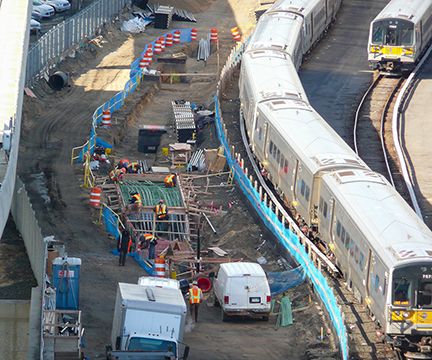 To handle the increased station traffic resulting from the East Side Access project—LIRR’s new connection to Grand Central Terminal—Jamaica Station was in need of an upgrade. As part of the LIRR’s $301 million Jamaica Capacity Improvements (JCI), Phase I Project, the Johnson Avenue Yard Reconfiguration design-build project established the groundwork for a key future enhancement to the station complex—a new station passenger platform dedicated to Atlantic Terminal service. This new structure, Platform F, as well as associated track reconfigurations, isolated the tracks leading to and from Atlantic Terminal and mitigated associated route conflicts with Manhattan-bound trains, thereby allowing increased train throughput in the station and providing for the future needs of Grand Central Station service plans.
What We Did
Gannett Fleming provided resident engineering and construction management expertise to guide this project through complex construction challenges and to a successful on-time completion. Key elements of the Johnson Avenue Yard reconfiguration project included realigning and re-profiling 5,500 feet of track and 350 feet of the yard lead track; installing four new track switches; raising the elevation of the eastern half of the yard; developing an underground track support system for a portion of the yard lead track under the AirTrain building; constructing a 1,230-LF retaining wall system; and implementing new lighting, public address, and closed-circuit television systems. Because of the location of the future platform, an existing utility duct bank and manhole system containing critical railroad power, signal, and communication cables also needed to be relocated.
From the beginning, the project presented significant challenges, particularly when it came to constructing a system to support the lead track’s raise and realignment and relocating critical railroad utilities. Following extensive surveying of the area, the team drilled 77 micropiles through the existing lead track and tieback area without disrupting 130 structurally critical tiebacks. The team accomplished the drilling despite low headroom of 16 feet. The conduit system for the utilities also posed a problem. Although the original plan called for running the conduits via two duct banks, the project team developed an alternative – running all the duct banks in a single trench, reutilizing a portion of the existing duct bank system, and constructing it all in a single stage of work. The solution reduced the number of times the duct crossed each other and under the tracks.
Key Features
- Micropile-reinforced relieving platform supports the lead track and eliminates loading on the AirTrain Building
- Doublewal® retaining wall system supports the raised elevation of the eastern half of the yard
- Single trench provides easy access to 26,000 LF of power supply and 21,000 LF of communication conduits.
Client: Metropolitan Transportation Authority (MTA)
Partner(s): Picone/Schiavone II, Stantec, GG Engineering, HNTB Corporation
Location: Queens, New York
Gannett Fleming Role: Construction Manager/Resident Engineer
Data:
Construction Cost - $27 million
Completed - 2016
Type - Rehabilitation
Duration - 2 years, 9 months
Outcomes -
- Mitigated associated route-conflicts with Manhattan-bound trains
- Enabled increased train throughput in the station
- Improved access to the utility conduits which reduced the need for track outages during future maintenance.
This project information was published on the Gannett Fleming Projects website.